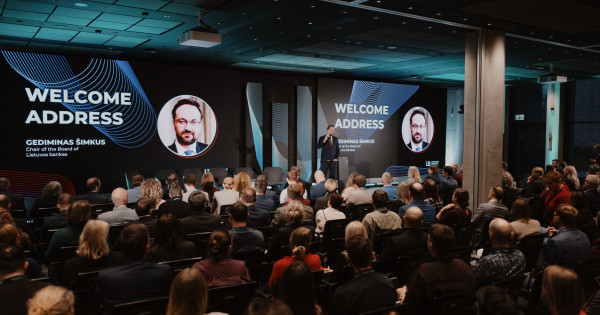
Lietuvos banko valdybos pirmininko Gedimino Šimkaus kalba per 2026 m. lapkričio 13 d. Vilniuje vykstančią tarptautinę metinę ekonomikos konferenciją „Proveržis pažangiuose sektoriuose: nuo pasaulinių idėjų iki sprendimų Lietuvai“.
Lietuvos banko organizuotos konferencijos metu diskutuojama apie tai, kas lemia pažangių sektorių proveržį, kokios kliūtys stabdo Europos konkurencingumą ir kaip Lietuvai pereiti į kitą ekonomikos augimo etapą, kuriame svarbiausią vaidmenį atliktų žinios, technologijos ir aukštos pridėtinės vertės kūrimas.
Daugiau informacijos apie konferenciją.
Kalba sakyta anglų kalba, šis tekstas nėra kalbos nuorašas.
Prime Minister Mindaugas Sinkevičius, Your Excellencies, Honourable Members of Parliament, Distinguished guests, Ladies and gentlemen,
good morning, and welcome to the tenth annual Economics Conference of the Bank of Lithuania.
Let me begin with chess.
It’s a game where even the weakest piece can become the strongest. A pawn that makes it all the way across the board can be promoted to a queen.
But to get there, it needs what chess players call a breakthrough – moves that open the way through the opponent’s lines.
It is no coincidence that “breakthrough” is also in the title of our conference. Some may say that Lithuania is just a pawn – a small piece on the board.
But in chess, size does not decide the game. A clear strategy does.
Today’s conference, therefore, is about our game plan – the strategy that will decide how we achieve the next breakthrough in advanced sectors, where knowledge, technology, skills create the highest value.
In this game, Lithuania has already played a remarkable opening.
We joined the European Union and NATO in 2004. We adopted the euro in 2015. We integrated our economy into the Single Market and European value chains.
Last year, Lithuania’s GDP per capita reached 87 percent of the EU average. At the time of joining the EU, it was roughly half. Few countries in the world have closed the income gap that fast.
This was not luck. It is the result of our choices and discipline to follow through.
However, we have also to admit that those moves were to some extent played by the book. We adopted European rules, institutions and standards – a tested model that we made work for Lithuania.
But now we are approaching the limits of growth, which is based on catching up, cost advantages and adopting existing technologies. The old playbook will not take us much further.
In fact, the same applies to Europe. The European economic model is falling behind the technological frontier set by some other jurisdictions.
So, we all find ourselves in the middlegame. At the frontier, where there is no complete rulebook to transpose. And the frontier itself keeps moving.
Ladies and gentlemen,
every game has an opponent. So, who is ours?
It is not really the United States or China.
Our opponent is inertia, comfortable mediocrity.
Standing still is not a safe option. Technologies change fast; competitors improve. If we just stay where we are, we will only fall behind.
To move forward, we need a strategy – one that makes clear choices and focuses on a limited number of priorities for change.
I would identify three priority areas: research and development, diffusion, and scaling – turning talent into innovations that reach the market, spreading technology and know-how across the economy, and helping innovative firms grow into global leaders.
First, research and development. In Lithuania, we have one of the most educated young generations in Europe. At the same time, Lithuanian businesses spend just 0.4 percent of GDP on research. The share of researchers working in Lithuanian businesses is less than half of the EU average. And we are only in the middle of the global table for patent applications relative to the size of the economy.
In other words, we do have talent. But too little of it turns into new knowledge that can reach the market.
Therefore, there is a necessity for better focus on how we can increase collaboration between science and industry. We need to strengthen R&D spending incentives, which are used rarely by Lithuanian businesses.
Second, diffusion of technology and know-how. We see a large gap in Lithuania between the most productive and least productive firms. More spending on innovation alone will not solve this. An economy-wide breakthrough requires spreading the technology and know-how from the most productive companies to the wider economy. This is how our individual success stories can turn into broad-based growth.
For instance, in Lithuania we discuss a lot about attracting of foreign investors, but in fact this is just the beginning of the story. The real impact comes when that investor brings Lithuanian firms into its supply chain – and shares its knowledge.
Third, scaling. Some of you may find this surprising: Lithuania ranks first in the world for the combined valuation of its unicorns relative to GDP.
But if we look at the real economy, our most advanced sectors, such as ICT, life sciences and advanced manufacturing, create only 13 percent of our value added.
Europe faces a similar challenge: too few of its companies grow into large global leaders. Of the world’s 100 most valuable companies, 62 are American and just nine are from the EU. Of the 21 tech companies among the top 100, only two are European.
For Lithuanian firms, Europe is our home market. A deeper Single Market, integrated capital markets and less red tape would help companies scale across the continent. A breakthrough for Europe is a breakthrough for Lithuania.
The final key to these priorities is that they require strategic discipline. Advanced capabilities take years to build. Priorities must survive political and budget cycles.
And consistency is not stubbornness. A good chess player holds on to the plan, but not to every move.
Ladies and gentlemen,
no single conference can write a strategy. But it can test proposals and sharpen priorities. That is what we aim to do today – moving, as our title suggests, from global ideas to solutions for Lithuania.
We start with Europe. In her keynote, ECB Executive Board Member Isabel Schnabel will speak about Europe’s innovation and competitiveness. Professor Ricardo Reis will ask how to let large European firms grow.
In the second session, Professor Reinhilde Veugelers from Bruegel will look at what makes innovation scale, including lessons for small open economies. My colleague Kotryna Tamoševičienė will discuss how Lithuania can write the next chapter of its growth story based on knowledge, technology and higher value added.
Each session will end with high-level panels – with leading voices across business, academia, and public policy.
Throughout the day, we will talk about breakthroughs. So, I invite all of you to think boldly and speak openly. With that, I warmly welcome you to the conference.
Thank you.


