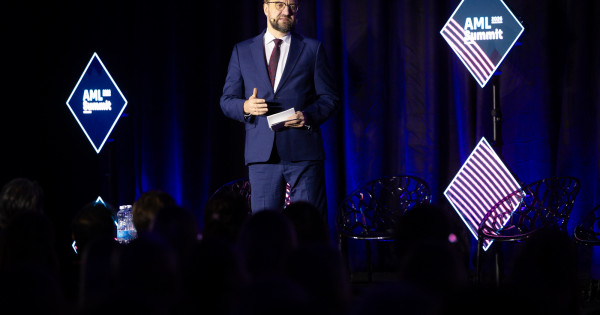
Lietuvos banko valdybos pirmininko Gedimino Šimkaus įžanginė kalba per 2026 m. spalio 27 d. Vilniuje vykstantį „AML Summit 2026“ renginį, kuriame aptarti pinigų plovimo ir teroristų finansavimo prevencijos klausimai.
Kalba sakyta anglų kalba, šis tekstas nėra kalbos nuorašas.
AML Summit, 27 October 2026 – Welcome Speech
Good morning colleagues, ladies and gentlemen,
Welcome to the AML Summit and thank you to the organisers for bringing the community together for the past eight years.
Lietuvos bankas is partnering with the Summit for a second year because we believe no single institution can keep our financial system safe on its own. We need to work together: financial service providers, AML professionals and public authorities, including us as the supervisor.
Last year I spoke about the integrity of the financial system as part of our country’s critical infrastructure. That has not changed. This year I want to be more practical.
Two things are coming, and both need your attention now. The new European AML rules apply from 10 July 2027. And Lithuania’s MONEYVAL evaluation is planned for October next year. Let me say a few words about what each will mean in practice and how we can prepare together.
First, the new European AML framework.
The deadline is precisely 256 days away. I understand why many of you see the transition with a degree of uncertainty: important technical standards and guidance are still being developed, and the necessary changes to national law have not been adopted yet.
I will not pretend that every question already has an answer. It does not.
But we should not wait for every last detail before preparing. Financial service providers can already assess what the new rules mean for customer due diligence, ongoing monitoring and the business-wide risk assessment.
The preparation matters because the AML package is a significant and demanding change. It will require substantial investments in people, expertise, data, technology and internal control systems. It will also require time: time to review processes, train staff and turn the new requirements into everyday work.
Still, it would be a mistake to see the AML package only as an additional compliance burden. Some of you have raised concerns that the rules are not always applied in the same way across the European Union. The new framework should change that. It should create less room for regulatory arbitrage, more consistent supervisory expectations and greater certainty for firms operating across borders.
My second message is on MONEYVAL.
The on-site evaluation is planned in a year, which may still sound distant. But the preparation has already begun.
I want to emphasize this: it is not an assessment of Lietuvos bankas, nor a test for public institutions. It is an assessment of the whole Lithuanian system. It covers supervision, financial intelligence, law enforcement, other public authorities, and the private sector.
MONEYVAL is not just another technical exercise either. The evaluators will of course look at the legal and institutional framework. But their central question will be this: does the system work in practice? Do we understand the risks that are relevant to Lithuania? Do the measures we apply respond to those risks? And can we show, with sound data and practical examples, that they achieve results?
This is the difference between rules on paper and an effective system in practice.
That is where all of you have an important role to play. Some of you may be asked for information, explanations or anonymised examples. And some of you will meet the evaluators. Being prepared means being able to explain the risks that arise from your customers, products, geographical reach and technologies; how you manage them; and what evidence shows that your controls actually work.
The outcome matters for Lithuania’s reputation and for international confidence. Serious weaknesses could mean more intensive checks on Lithuanian institutions and their clients, more questions and documentation, and more difficult correspondent banking relationships. In practice, this can result in slower and more expensive international payments, greater de-risking and more friction for trade, investment and access to finance.
A weak outcome would not affect one institution only; it would carry long-term reputational and economic consequences. This is why we see MONEYVAL as a national priority.
We have good reasons to be confident that MONEYVAL will recognise Lithuania’s progress. But confidence is not a substitute for preparation.
Lietuvos bankas will support you in this work. We will organise discussions, training and practical guidance. Some of you will take part in mock interviews with us.
But we do expect active engagement in return: timely and reliable information, openness about challenges, and a willingness to improve where improvement is needed.
Latvia’s recent MONEYVAL evaluation offers a useful lesson: good results rest on a shared understanding of risks and coordinated action between the public and private sectors. I hope we will hear more about Latvia’s experience from Toms Platacis in the next panel discussion.
Before I hand it over, let me leave you with three messages.
First: MONEYVAL is a national priority, and the key question will be how rules work in practice?
Second: start preparing now. The new European AML framework is demanding, but it is also an opportunity for a more consistent European rulebook and a more level playing field.
Third: Lietuvos bankas will guide and support you, but responsibility for being prepared is yours.
Thank you, and I wish you productive discussions.